AI Zalo chatbot for real estate: replies to buyers in 2 seconds
Minh Khoa
Founder & Tech Lead
Real estate buyers message on Zalo after hours, and slow replies lose them
In Vietnamese real estate, most buyers ask on Zalo: they see an ad and message right away to ask the price and whether units are left. Many messages come in the evening or at the weekend, when sales staff are out on site visits or off work.
Buyers usually message several projects at once. Whoever answers first, and answers the actual question, keeps the buyer. Reply 30 minutes later and the buyer is already talking to another project's sales team.
Sales teams also repeat the same work all day: answering "any units around 2 billion left?" again and again, opening the inventory sheet to see what is still free, and sometimes quoting a unit that someone has already put a deposit on.
An AI Zalo chatbot fixes exactly this: it auto-replies to Zalo messages 24/7, including messages sent to a Zalo Official Account after hours, then passes the buyer to sales.
Demo video: an AI Zalo chatbot that replies in 2 seconds
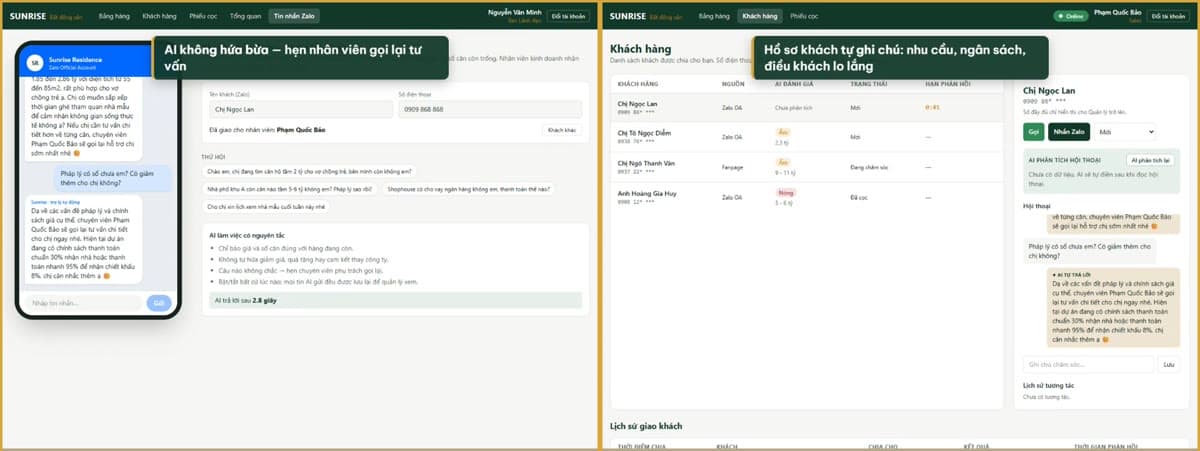
The clip below was recorded on a system DankTech built, using sample data. On the left is the buyer's phone on Zalo; on the right is the salesperson's screen.
In the clip:
- ✓The buyer asks for an apartment around 2 billion VND. About 2 seconds later the AI replies with the price range, sizes and the number of apartments still available
- ✓At the same time the buyer is assigned to a salesperson on duty, who sees the whole conversation
- ✓The buyer then asks about legal papers and for a discount. The AI does not promise anything and says the assigned consultant will call back
- ✓The buyer's profile fills itself in: needs, budget, interest level and remaining concerns
- ✓The salesperson taps Call to take over
Answers come from the live inventory, not a fixed script
A normal Zalo chatbot follows a script: the buyer taps a button or types a keyword and the bot sends a canned reply. Ask anything slightly different and the bot answers wrongly or not at all.
This AI chatbot reads the question like a person would and checks the inventory at the moment the buyer asks: how many units of each type are left, the price range, and which payment plans apply. When a unit is put on hold or gets a deposit, the AI stops offering it.
| Criteria | Scripted chatbot | AI chatbot on live inventory |
|---|---|---|
| How it replies | Canned text by keyword | Understands the question, writes a natural reply |
| Prices and units | Edited by hand when inventory changes | Read from the inventory when the buyer asks |
| Off-script questions | Wrong answer or none | Hands over to a consultant |
| What sales gets | Only the chat log | The chat plus an auto-filled buyer profile |
The chatbot does not make promises: when the AI hands over to sales
What developers and agencies worry about most is an AI promising the wrong thing. So the AI works under clear rules:
- ✓Only quotes prices, sizes and unit counts that are in the inventory, never invented numbers
- ✓No discounts or gifts beyond the current sales policy
- ✓No commitments on legal status, handover dates or loan rates. For those, the AI says the assigned consultant will call back
- ✓Always invites the buyer to visit the show unit
- ✓The AI can be switched on or off at any time. Every AI message is saved and marked so managers can review it
The AI only keeps the buyer engaged while they wait. Sales staff still do the real consulting and closing.
Buyers are assigned to sales automatically, with a profile ready
When a buyer messages for the first time, the system:
1. Checks for duplicates: the same phone number does not create a new buyer, so two salespeople never fight over one lead
2. Assigns the buyer to the next salesperson on duty
3. Starts a response timer: sales must call or message within the set time (for example 5 minutes). If they miss it, the buyer moves to someone else and the miss is logged for KPIs
4. Has the AI read the conversation and fill in the profile: budget, product type, hot, warm or cold, main concerns, and reasons for hesitating
An AI reply does not count as a sales response. The timer keeps running until a salesperson actually contacts the buyer.
Buyers, messages, assignment history and follow-ups all live in one AI-powered real estate CRM, so managers can see which salespeople reply fast and which buyers are hot.
Who is it for?
- ✓Real estate agencies with many salespeople and leads from Zalo and Facebook
- ✓Developers who want control over inventory and how fast agencies follow up with buyers
- ✓Project sales teams running ads, with lots of messages in the evening and at weekends
How is it set up?
1. Discuss your needs: which channels buyers use (Zalo OA, personal Zalo, Facebook page), team size, response-time rules
2. Load your inventory and sales policies so the AI answers from real data
3. Set the AI's rules: which questions it may answer and which go to a consultant
4. Pilot with one sales group, review the AI's replies and adjust
5. Go live, with documentation and training videos handed over
FAQ: AI Zalo chatbots for real estate
Zalo Official Account or a personal Zalo account?
A Zalo Official Account (OA) is the better choice, because Zalo officially allows software to connect to an OA. Personal Zalo accounts can also be pulled into a shared inbox through conversation tools, but auto-replying from a personal account risks Zalo restricting it. For personal accounts we can build a mode where the AI suggests a reply for the salesperson to review and send, rather than sending it itself.
Can the AI give wrong answers?
The AI can misread a question, so the system is built to keep that risk as low as possible: the AI only uses numbers from the inventory, hands uncertain questions to a consultant, and may not make promises about price or legal matters. Every AI message is saved and marked, so managers can review it and tighten the rules. During the pilot, the AI can be set to reply only outside working hours.
Does customer data leave the business?
Customer data stays in a database owned by the business. To write a reply, the system sends only the relevant conversation and an inventory summary to the AI service. In production you should use a paid AI plan, where the provider commits not to train on the data. Salespeople only see masked phone numbers and call through the built-in call button, which makes it harder to take buyers elsewhere.
Does it work with a Facebook page and website forms too?
Yes. Facebook page messages and website sign-up forms flow into the same buyer list and go through the same duplicate check and assignment to sales. If your project has no sign-up page yet, see our website design service.
What do we need to get started?
- ✓Inventory in Excel: unit code, product type, size, price, status
- ✓Sales policies: payment plans and current discounts
- ✓A list of salespeople and your response-time rules
- ✓The project's or agency's Zalo OA, if the AI should reply directly on Zalo
If your sales process still runs on scattered spreadsheets and you want to rework it end to end, read how we approached digital transformation for public-sector staff management or see our digital transformation consulting service.
Where to start?
Read more on ready-made versus custom software and our custom software development service. To see a demo on your own project's inventory, contact us.